Buying Your First Guitar (cont.)
This post is a continuation from last week. I'll give you my recommendation for the best guitar to buy as a beginner student.
What Type of Guitar Should I Buy?
I recommend a nylon-string classical-style guitar as a first instrument. “Wait,” I hear you say: “I want to play rock guitar, not classical.” The truth is, regardless of what style you ultimately intend to play, you’ll likely be better served starting on a nylon string classical style guitar. Later on, you can move to whatever instrument you want, but as a first step, the nylon string classical makes a lot of sense to me. Here’s why:
Nylon String Guitars Provide the Best Quality at an Entry Level Price-Point
The nylon-string classical-style guitar is a simple design. Other types of guitars are more complicated. In electric guitars, there is a whole collection of “extra” parts working together to make the sound. However, even steel-string guitars require special reinforcements in order to bear the extra load that these stings put on the guitar. All these “extras” add to the cost of production. So while it might be true that there are electric guitars for sale for a comparable price to the nylon-string guitar that I recommend, it's unlikely that they will be musical instruments of quality.
The Nylon String Guitar is an Appropriate Choice For A Beginner
My dad is a great woodworker. (He actually made my favourite guitars!) He told me a story (perhaps it was more of a fable) about a Japanese apprentice who brought a top-of-the-line wood plane. When the apprentice took the tool to show the master, the master rebuked the student. “This tool is too good for you,” the master said; he took the tool for himself, and that was that. While we might cry at the injustice of such a story (and don't worry, I've never confiscating a guitar from a student 😉), what I believe the master was getting at is that when we commit to learning anything, we're joining a tradition. We're connecting with generations of learners who've gone before us… if we're looking for the fast way, we've already lost sight of what attracted us to this special thing in the first place. Good things take time. With a simple instrument that's not equipped with all the latest innovations to facilitate our way forward, we learn more about the guitar (not to mention more about ourselves). To put this into context with a practical example, there's a place in the fret where one must place one's finger in order for the note to sound true. On some very high-end guitars, you might have a wider window within which to place your finger before the guitar gives an undesirable buzz. However, the fact remains that there is an ideal place to put your finger: right behind the fret (not on it, but rather just behind it 😉). Now, while your guitar heroes may play guitars costing thousands of dollars, I wager that all of them will place their fingers in the correct position. Whether they might get away with another placement on their fine instruments is irrelevant. They are invested in playing the guitar as it was intended to be played—lessons they probably learned from starting on a no-frills guitar.
When You Do Upgrade, You'll Appreciate it.
Over the course of my career as a guitar teacher, I’ve come across many sorts of students at different stages in their lives and with different budgets. Some want to buy a really great guitar and they have the means to do so. While I won't stand in the way of the student who wants to spend-up on a really great instrument, I always feel a little sorry for them. In doing so, they deny themselves the opportunity to really discover what it is about that instrument which makes it so great.
Each time in my life when I've been able to upgrade my instrument, it has come after a long period working with a “lesser” instrument. You grow with an instrument until you come to a point where it has taught you what it was meant to. Then it is perhaps time to look further afield. On upgrading my instrument, I've marveled at how easily it facilitated something that I was striving to achieve on a previous one. The feeling is indescribable to those who haven't experienced it. With really top instruments, there is no limit to what they can teach us. But to appreciate this “infinite” quality of a concert quality instrument, you need to have run up against the limitations of a lesser one.
Is There A Specific Brand/Model of Guitar I Should Buy?
Yes! Though there are many good options out there, I've found the most bang for buck to be the Yamaha C40. I have no affiliation with Yamaha whatsoever, but over the years, having taught literally hundreds of students (many of whom started on a C40), I'm yet to encounter a “dud.” I should note also, that while some other brands may seem to offer something very similar to the C40, without mentioning any names, I can say that many of these are not of comparable quality.
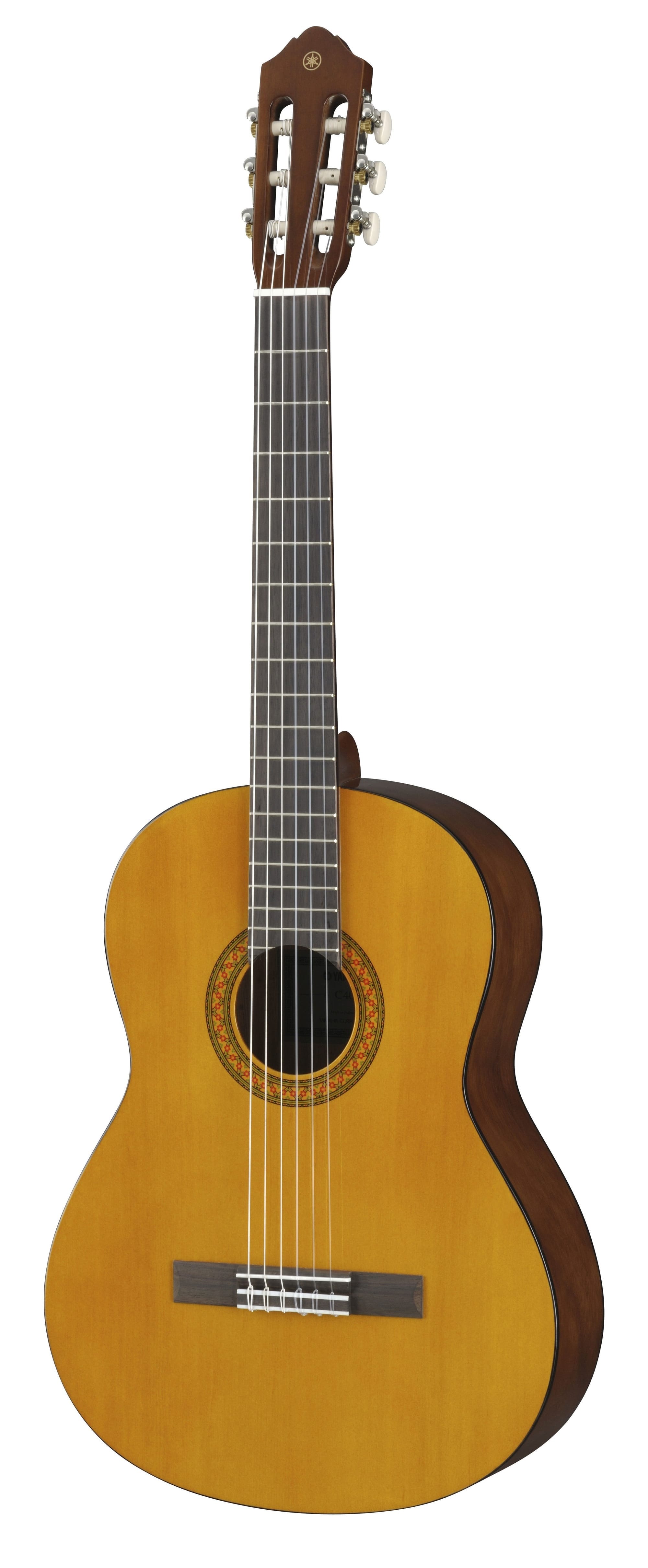
Yamaha has a few incarnations of the C40, denoted by the letters in suffix, including a C40X, which adds the ability to plug the guitar into an amplifier using the inbuilt pickup. I wouldn't recommend this option. The pickup sounds… well, cheap! You probably won't need to play your C40 amplified, and if you ever did need to, there are some good external pickups that you can attach to the guitar to get the job done.
Where Should I Buy My Guitar?
Honestly, you should go to your local guitar shop and buy it there. In my hometown of Brisbane, Australia, there's a fantastic shop that I grew up going to: https://www.theguitarshop.com.au. It's like a family; I know the staff there, and they know me. I can send students to them and be sure that they'll be well looked-after. Now, I'm not suggesting everyone order from the Guitar Shop, Paddington; that's not the point. (Though, if you're in the area, definitively stop by!) The point is to try to support local business, if you can. Even if it costs you a bit more than one of the big online stores, you'll have peace of mind knowing that support is there if you need it, long after the sale.
That’s it for now. Next week, we’ll wrap up this series of posts by outlining some of the must have accessories to buy with your first guitar!