Making a Go of It
In the end, successfully learning a musical instrument comes down to this: showing up.
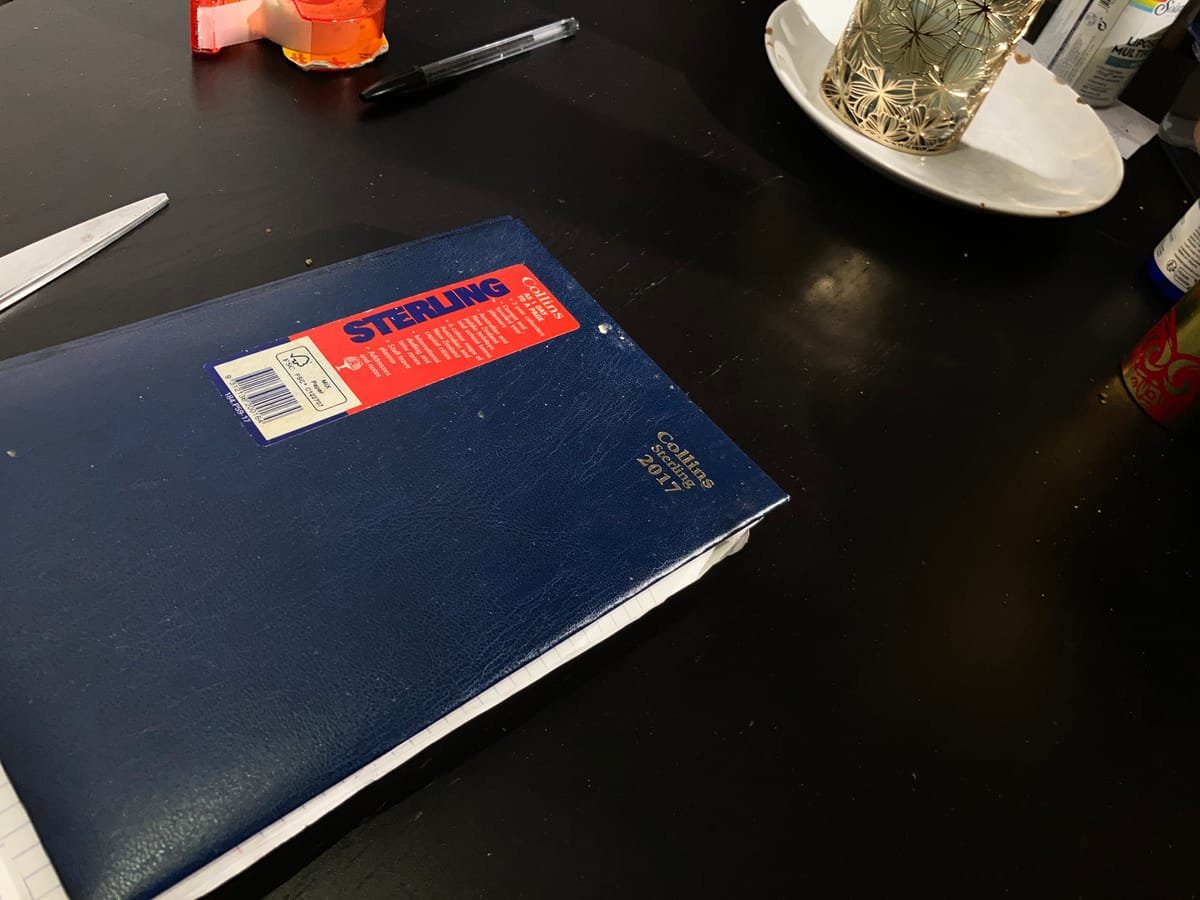
For as long as I can remember, my Dad has kept a diary (what American readers would call a journal). It’s always the same type: a Collins A5 format diary with a blue cover. He gets one each year as one of his Christmas presents, and every year around this time, he also reads back through his journal for the year that was; the cycle continues. It's not uncommon for him to read you an extract from his diary— something that concerned you. There's something about the passage of time that changes our experiences, or perhaps, more correctly, it is we who change with the passage of time. To be able to observe ourselves—at a given moment in time as we articulate our hopes and concerns—with the benefit of hindsight is a powerful tool. Recollecting is a word that's often bandied about when we speak of memories, but its etymology points to a deeper understanding of what is actually at work here. We “re” - ”collect”; we revisit our experiences from the ever-changing perspective of our own consciousness.
Whenever my dad shares something from his diary, it inevitably evokes the same response: “I should keep a diary,” I think to myself. However, in reality, it's never that simple. To be sure I've tried. I put all sorts of measures in place to try and achieve the goal. I start with the same type of diary (a blue Collins’ diary, like Dad's); one year, I even went to the length of buying a special pen which I would write my journal. Nothing ever seemed to work. Moreover, these faltered starts loom over me, menacing any future attempt I might make to keep a diary. Even though I’ve only lived in France for six years, I still managed to dig one out. From 2017–the year I moved here. Looking through it, I note the pattern common to all my diaries. I start by saying that I’m not good at sticking the habit of journaling. I then write pretty consistently through January and into the start of March. However, toward the latter half of March, blank pages assume greater prominence. By April, it’s all but over. There are a few feeble attempts to resurrect it throughout the year, but, unlike my initial attempt, these are never more than a couple of days long.
Why all this talk about my failed journal attempts? It's because I think we can learn a lot from them in relation to learning a musical instrument. New Year's resolutions are all well and good, but, personally, I don't really like them. They set you up for failure. Strong habits, like those of my father's diary keeping, aren’t formed through sheer will power alone. At the same time, when learning something like a musical instrument—when learning anything really—a gentle but unwavering commitment is an absolute prerequisite. Moreover, it's a commitment which is renewed each time you return to the instrument, to your composition, to whatever it may be.
It's like a garden: you need to tend to it without expecting to see any fruits for your labours. First and foremost, you need to enjoy just being in the garden. In order to grow something (and not have it choked by weeds, or die from lack of water, or any other number of reasons) the ambition of your garden needs to be aligned with the time that you will be reasonably able to commit to it. For the avid green thumb, living in a house with a yard and lots of time to devote to their gardening projects, a large garden with many different plants may be feasible; for someone working a busy job, living in an inner city apartment, growing some herbs in a pot on the windowsill might be all that is feasible. Crucially, In both cases, the garden will only survive with regular care. The key word here is regular, and it’s also the key word when thinking about learning a musical instrument. Here are some points to keep in mind when learning a musical instrument.
No matter how much you’ve wanted to learn or for how long, passion is not enough.
In the end, successfully learning a musical instrument comes down to this: showing up.
You’re running a marathon, not a sprint.
I always tell my students do a little bit a lot rather a lot a little bit. Five minutes a day is far better than practising for 35 minutes non-stop once a week; this is backed up by neuroscience. Even if you do want to go for longer I would recommend restricting your practice at first, until you can be sure that devoting more time to your music will not put you behind in other things. Because, once the pendulum swings back, you’ll be having to sacrifice the regularity of your music practice in order to catch up on what you didn’t do when you were happily practicing. Again, regularity is key. Do a little bit today so you're hungry for more tomorrow. Over time, you can gradually increase your practice time. I think if I'd started my diary by just writing down three things that happened each day in point form, I would've succeeded in my goal. Instead, I tried to fill the page with wordy prose.
There will be times when you cannot achieve your goal, even times where you stray completely from your objective.
Don't lose heart. Strong habits come from modest objectives, but when strong habits falter (and they will from time to time), we must be gentle on ourselves. Learning a musical instrument is a little bit like life. It shows us who we are along the way, but it's not always smooth sailing, and it's not always as we expect. In the end, if we can continue to show up, accepting the detours and the mishaps as part of the journey and learning to love these too, we will have done what was required of us. This year, I've decided not to try another diary – this year I'm going public! I’ve been wanting to do a blog on learning music for quite a while now, so I’ll start by applying some of the same principles I've outlined above. Subscribe to see how I get on.